
Four Generations, One Office: Making a Multigenerational Team Work
Walk into almost any Sussex office and you’ll find people at very different stages of their working lives sharing the same space. One colleague might be showing someone a useful new shortcut. Ten minutes later, the lesson may run the other way when a difficult client call needs a steadier hand.
That mix is now a normal part of working life. Baby Boomers, Gen X, Millennials and Gen Z routinely work alongside one another, with 73% of British senior business leaders managing a multigenerational workforce. People are also moving between roles later in life. Globally, the average person starting a new job is now over 42.
This doesn’t need to become another problem for an already busy SME owner. Managed well, a mix of ages gives a team more experience, more perspectives and more ways to solve a problem. The office is also one of the few places where those perspectives regularly meet.
What Each Generation Wants, and What It Doesn’t
A birthday isn’t a personality test. It’s easy to sort people into neat generational boxes, but life stage often tells us more than age alone.
Even so, the broad patterns can help explain why colleagues sometimes approach work differently.
Gen Z have entered work during a fairly unsettled period. 37% worry that AI could take their job and 86% say they’ve experienced stress at work. Balance matters too. 62% would accept less pay for a better work-life balance, while one in four would rather move employer than wait for an internal promotion.
Many Millennials are now firmly mid-career. They’re balancing ambition with childcare, elder care or both, often while managing other people for the first time. Loyalty shouldn’t be taken for granted: more than a quarter of people aged 25 to 34 plan to change industry in the near future.
Gen X often hold a large share of an organisation’s experience and management responsibility. They’re also easily missed by workplace initiatives aimed at either young talent or later careers. Add school runs, ageing parents and senior responsibilities, and “the reliable one” may be carrying rather more than anyone has noticed.
Older workers are a growing part of the picture too. 11.5% of the UK population now works beyond 65, which is twice the proportion recorded in 2000. Here in the South East, 75% of people aged 50 to 64 are in work, the highest rate in England.
The most useful finding is that the generations have plenty in common. Career development, flexibility, balance, belonging and shared values matter across every age group. People may ask for these things differently, but the needs underneath are often much the same.

Where the Misunderstandings Start
Mixed-age teams bring benefits, but they don’t run on goodwill alone. 39% of senior leaders report communication and collaboration difficulties in a multigenerational workforce.
A few familiar situations tend to cause most of the trouble.
Slack, email or a tap on the shoulder? One person sends a message. Another calls. A third walks across the office because it will “only take a second”. None of them is necessarily wrong, but the team needs to agree which channel suits which job.
Feedback can mean different things to different people. A younger colleague may expect regular recognition and quick comments. Someone with a longer career may prefer more space and find constant feedback a little wearing. According to Tim Mitchell of Oxford Business College, “different generations communicate and contribute in different and distinct ways, especially in an era with technology and AI moving at a rapid pace”.
Flexibility must feel fair. Hybrid working quickly causes resentment if it becomes known as a perk for one age group. Whatever someone’s life stage, “this flexibility needs to be for everyone”.
AI anxiety runs in both directions. Some younger workers fear the loss of entry-level roles. Some older workers worry that they’ll be judged for not knowing tools they were never taught. Digital confidence isn’t a simple matter of age, either. Around 21 million working-age adults lack at least one essential digital skill.
Five Practical Things a Sussex SME Can Do
You don’t need a large HR department or a new policy for every birthday. A small team can make useful changes quickly.
1. Help Managers Understand Age Diversity
Only 21% of employers train line managers to support multigenerational teams. A focused half-day session can help managers spot assumptions, handle different feedback preferences and make flexibility decisions more consistently.
It’s a modest investment beside the £11,000 to £75,000 cost of replacing one employee. Recruitment, onboarding and lost productivity soon make an avoidable departure rather expensive.
2. Agree How the Team Communicates
Decide together what Slack or Teams is for, when email makes sense and which conversations need a room and two cups of tea. The precise rules matter less than having rules everyone understands.
It also helps to ask rather than assume. “How do you prefer to receive feedback?” is a much safer question than guessing from someone’s age.
3. Let Mentoring Work Both Ways
Pair newer and more experienced colleagues around a real task. One may share a faster way to use an AI tool or platform. The other may bring years of client judgement, context and pattern recognition.
More employers are now using mentoring, reverse mentoring and shared learning programmes for exactly this reason. Done well, two colleagues simply come away with more useful knowledge.
4. Apply Flexibility Consistently
Judge requests by the work, not the applicant’s age. A 65-year-old asking for compressed hours and a 25-year-old asking for two days at home both deserve the same practical question: can the work still be done well?
Consistency won’t mean that every role gets identical arrangements. It means the same reasoning applies to everyone, with the decision explained clearly.
5. Give People More Than One Way to Work
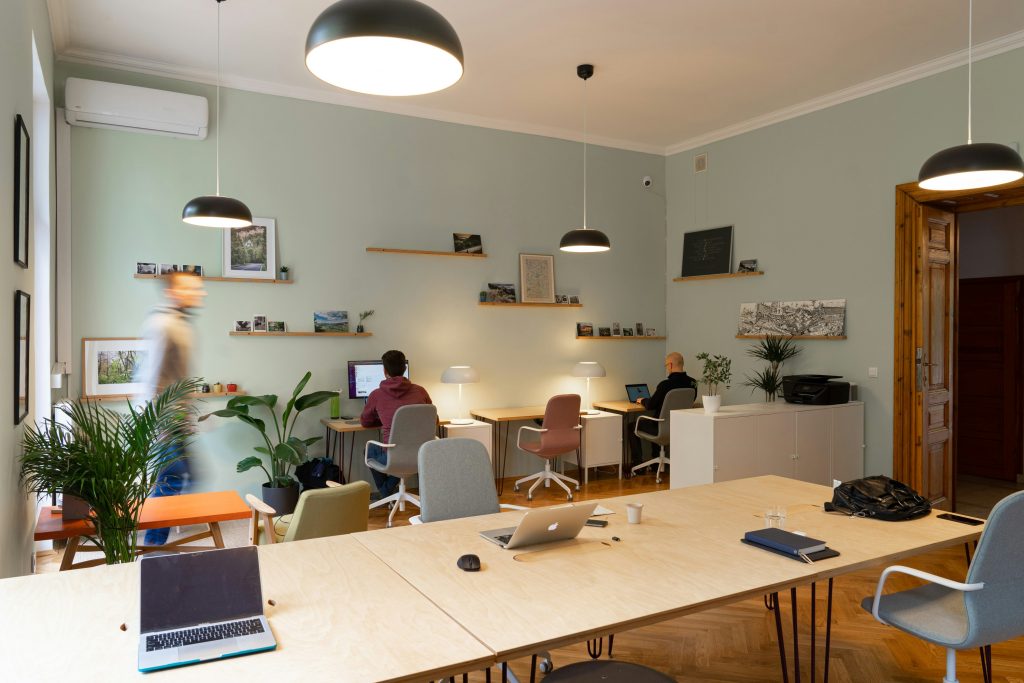
An office designed around a single working style will always make somebody work harder than necessary. People need quiet places to concentrate, open areas for conversation and meeting rooms they can use without planning three days ahead.
The preferences may not be what you expect. In one global workplace survey, workers over 65 showed the strongest preference for open environments. The private corner office isn’t everybody’s dream after all.
We’ll admit to being a little biased here. A serviced office already set up with private suites, meeting rooms and shared areas removes a sizeable job from the to-do list. It gives a small team room to work in different ways without taking on a full office fit-out.
Why the Office Still Matters
Remote work can be useful, but it doesn’t automatically bring different generations together. People drift towards their preferred channels. Some live in Slack, others rely on email or phone calls, and the ordinary kitchen conversation disappears.
That matters because younger workers aren’t all trying to avoid the office. 45% of Gen Z workers are considering roles with more social contact, while 38% feel isolated by their current arrangements. One worker wanted an office where they could find supportive colleagues, share lunch and make plans for the evening.
At the other end of the working-age range, nearly two-thirds of extended-career staff prefer to work full-time in the office. Loneliness is not owned by one generation. 58% of UK employees feel lonely at work at least some of the time, while 42% have considered leaving or have left a job because of it.
The office cannot fix loneliness on its own. A room full of people can still leave some people feeling isolated. But a good office gives everyday contact somewhere to happen, from asking for help with a task to discovering that the person in accounts shares your inexplicable fondness for a very specific minty biscuit.
That is where a mixed-age team starts to become more than a demographic statistic. With the right culture, age diversity becomes a practical advantage.
For a Sussex SME, that doesn’t call for a grand change programme. It calls for a workplace people want to use, whether that is a base in central Brighton or an office overlooking the runway at Shoreham Airport. The aim is to help people mix, not merely give them the same postcode.
A Final Word on Age
Age is a protected characteristic under the Equality Act 2010, just like sex, race and disability. That protection applies to younger and older workers alike.
Calling an older candidate “overqualified” can sometimes disguise an assumption about age. Dismissing a younger colleague as “entitled” can do much the same thing. In practice, age alone has a significant effect on someone’s chance of being in work.
There is a strong business reason to look past those assumptions. Extended-career workers report the highest workplace performance scores and a 91% likelihood of staying with their organisation. Almost half of the UK’s 4.3 million self-employed workers are over 50, while the South East has a particularly deep pool of experienced people still in work.
That is local talent worth recruiting. It is also worth keeping.
Managing four generations well isn’t really about learning four sets of stereotypes. It’s about building a workplace where people can do good work, learn from each other and be judged on more than the year they were born.
If you found this useful, you might also enjoy our guides to crafting a connected company culture, the shift towards flexible work and what employers can do about the workplace wellbeing crisis.
Looking for new serviced office space in Brighton & Shoreham?
Call us on 01273 917977 or complete our enquiry form.
Call on 01273 917977 or complete our enquiry form
enquire book a viewing