Building a Customer Retention Engine for Sussex SMEs
Acquiring a new customer costs anywhere between 5 and 25 times more than keeping one already on the books. That figure comes from Harvard Business Review, citing Bain & Company research, and it has been repeated so often because it keeps being true.
For Sussex SMEs operating on tight margins- and most are – that gap matters. Every pound spent chasing a cold prospect could, in theory, be doing considerably more work spent keeping an existing customer happy. Yet most small businesses spend the bulk of their marketing energy on acquisition: ads, social reach, footfall campaigns etc. The returning customer often gets an afterthought.
A customer retention engine changes that. Not a loyalty card, not a monthly newsletter – though both can play a role. A retention engine is a connected, systematic approach to keeping customers engaged, satisfied and moving back toward repeat purchase. Build one properly and it generates compounding returns over time. Ignore it, and even a healthy acquisition funnel will leave money – and customers – walking out the door.
The Maths Most SME Owners Skip
Before the tactics, it helps to understand why retention deserves to be treated as a financial priority rather than a soft, feel-good exercise.
Research has found that a 5% increase in customer retention rates can boost profits by 25% to 95%. The range is wide because it varies by industry, but even at the conservative end, the mathematics are striking. A 2017 Harvard Business School working paper went further: the average retention elasticity across firms studied was 4.9, meaning a 1% improvement in how many customers a business retains produces nearly 5% more customer equity.
That is not a 1% return on a 1% input. It is a 5% return. Compounding loyalty is structurally more powerful than most acquisition tactics.
There is also the question of when a new customer actually starts paying back their acquisition cost. The Bain & Company Mainspring Online Retailing Survey of 2,116 shoppers found that an average apparel customer was not profitable for the retailer until their fourth purchase – meaning the business needed that customer to return at least three more times before it had broken even on what it spent to acquire them. For online supermarkets, break-even came even later: 18 months after the first purchase.
The question worth sitting with is a simple one: how many first-time customers come back for a fourth visit?
And then there is the broader context. The Enterprise Research Centre’s State of Small Business Britain 2024, using ONS Business Structure Database data, found that of 325,811 UK start-ups registered in 2020, only 47% survived to 2023. Among those that did survive, just 14.5% achieved sustained growth across all four years. In an environment that unforgiving, the businesses most likely to sustain growth are those with a loyal, returning customer base – not those perpetually refilling a leaky acquisition funnel.
The Silent Churner Problem
Here’s the thing about customers who leave: most of them do it quietly.
According to the Institute of Customer Service’s UK Customer Satisfaction Index (January 2024), 41% of customers who are dissatisfied with a business say they simply avoid using it again. They do not complain. They do not leave a review. They just disappear. Only 1.5% of dissatisfied customers say they would spend more with that business going forward.
There is no redemptive arc for most of those lost customers. No angry email to turn into a win. They are gone, and the business frequently has no idea why.
The same UKCSI data makes an equally pointed observation: UK customer satisfaction stood at 75.8 out of 100 in July 2024 – its lowest level since 2010. That sounds bleak. For a Sussex SME that takes service seriously, it represents an opening. The bar for being genuinely outstanding has not been lower in 14 years.
There is also a direct connection here to cash flow. Dissatisfied customers who disengage are often the same customers who become slow payers, dispute invoices or quietly stop ordering before a payment falls due. Our previous post, the Small Business Cash Flow Survival Guide covers what Sussex SMEs can do when customers start behaving that way – but the better fix is keeping them engaged before it reaches that point.
What a Retention Engine Actually Looks Like
Before you roll your eyes at another meaningless buzzword, don’t worry, the phrase sounds more complicated than the reality.
Think of it as a connected set of habits and systems rather than a single initiative. Customer service processes, communication tools, feedback mechanisms, loyalty incentives and community-building activities – each doing its part, each reinforcing the others. The goal is to turn the experience of buying from a business into something worth repeating.
The six strategies below are the main levers. Most Sussex SMEs will not implement all six at once, and that is fine. One well-executed strategy beats six half-hearted ones.
Six Strategies for Building Your Retention Engine
1. Get customer service right before anything else
Everything else on this list depends on this. A loyalty programme cannot rescue a business that consistently disappoints, and neither can a well-timed email campaign.
The UKCSI data is direct. In the food retail sector, companies whose customer satisfaction score was at least one point above the sector average achieved annual sales growth of 5.8%, against a market average of 2.9% – effectively double. An earlier UKCSI wave found an even starker differential: 6.9% growth for above-average businesses versus 1.5% for those below average. That is not a marginal gain. It is a structural advantage built on something most businesses claim to prioritise but few measure.
Practical steps: audit every point where customers interact with the business and ask honestly whether the experience is good enough. Response times, complaint handling, how problems get resolved etc. In July 2023, only 58% of customers who reported a problem said the organisation responded positively. Being in that 58% is the floor, not the ceiling.
2. Personalise – without needing an algorithm
Personalisation is frequently discussed as though it requires sophisticated technology. For most Sussex SMEs, the tools are considerably simpler.
Research from the Data & Marketing Association’s Customer Engagement: Future Trends 2024 report found that brands rated highly on personalisation – specifically those offering frictionless experiences, targeted savings and localised offerings – achieve higher share of wallet and stronger emotional connection scores. That is not a recommendation algorithm. That is knowing who customers are and making them feel appreciated.
A basic CRM such as Capsule, HubSpot’s free tier, or even a well-maintained spreadsheet, is enough to record names, previous purchases and communication preferences. From there, relevant offers, birthday acknowledgements and follow-ups on past purchases become straightforward. The email list is also a financial asset worth taking seriously: the DMA’s 2023 Email Benchmarking Report puts the average lifetime value of an email address to UK businesses at approximately £36, with a typical subscriber staying on a list for around 2.5 years. A list of 2,000 local customers represents approximately £72,000 in future revenue – if it is managed well and used to communicate something worth reading.
3. Build a loyalty structure worth returning for
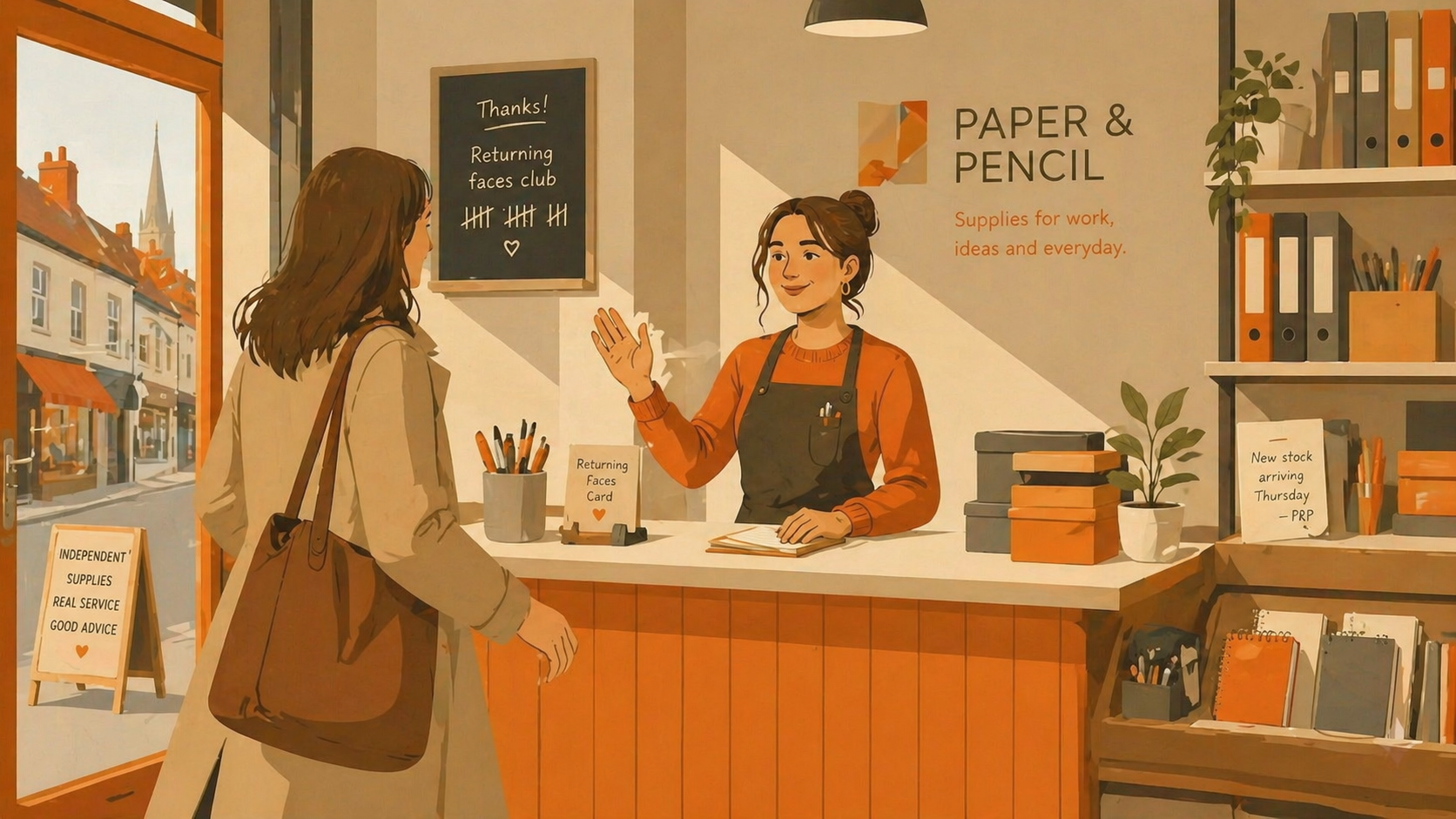
Loyalty programmes range from the straightforward (a coffee shop stamp card) to the more involved (tiered points systems with referral bonuses). For most small businesses, the simpler versions are both more achievable and more appropriate.
What the data suggests is that loyalty pays back in ways that extend well beyond repeat purchases. The Bain & Company Mainspring survey found that an apparel customer referred an average of three people after their first purchase – rising to seven after their 10th. For consumer electronics, the figure grew from just over four to 13 by the 10th purchase. The compound effect of a loyal customer is not just their own spend. It is the network they bring with them over time.
Referred customers are also valuable in their own right. Customers referred by loyal online grocery shoppers spent an additional 75% of what the original shopper spent over three years. For apparel and electronics, that figure exceeded 50%.
The connection between loyalty and local partnerships is worth making explicit. A Sussex SME that co-creates offers with complementary local businesses – the independent gym partnering with a nearby health food supplier, the accountant referring clients to a local marketing consultant – is building a retention structure that acquisition-focused competitors find difficult to replicate. There is more on building that kind of local supplier and partner network in our building a hyper-local business post.
4. Gather feedback – and actually act on it
There is an important distinction between collecting feedback and doing something with it.
UKCSI data, cited alongside KPMG Nunwood research, identifies what might be called a delight threshold: the loyalty dividend from a customer giving a business nine or 10 out of 10 is non-linearly larger than from a customer giving eight. The jump from “fine” to “genuinely delighted” produces an outsized improvement in loyalty, recommendation behaviour and repeat purchase.
That makes the goal of feedback collection clear: not to gather scores, but to identify what sits between a customer’s current experience and one they would score a nine or 10. A three-question Google Form, sent automatically after purchase or service delivery, is enough to surface the friction points worth fixing.
The businesses that read their reviews, respond to them publicly and make visible changes as a result build a specific kind of trust. Customers notice when feedback leads to action. Most of the time, it does not.
5. Win back lapsed customers
Before spending anything on new customer acquisition, check the customers who have already bought and gone quiet.
The probability of selling to an existing customer – even a lapsed one – is 60 to 70%, against 5 to 20% for a new prospect, according to research from Marketing Metrics. That gap makes a structured re-engagement approach one of the highest-return activities available to a small business with a limited marketing budget.
The mechanics are straightforward. Pull together a list of customers who have not bought or engaged in the past 90 to 180 days. Send them something direct – not a generic newsletter blast, but a short note acknowledging the gap and offering something specific. A time-limited discount, early access to something new or simply an invitation to come back for instance. Not all will respond. But the conversion rate, given the existing relationship, is far higher than any cold acquisition channel.
Real talk: The customer acquisition cost for social media advertising rose by more than 55% over the five years to 2022, according to L.E.K. Consulting. Against that backdrop, the lapsed customer list looks less like a tidying-up exercise and more like a structural competitive advantage.
6. Personalise communications – and make them consistent
Loyalty programmes and feedback loops do their best work when they sit inside a broader communication rhythm that customers can predict and trust.
Loyal customers who have made 10 or more purchases are not just spending more themselves – they are referring more people, spending more per transaction, and forgiving mistakes more readily. The Bain & Company data shows that repeat apparel shoppers spent 67% more in months 31 to 36 of their relationship with a retailer than in the first six months. The 10th purchase was nearly 80% larger than the first. That trajectory does not happen by accident. It is the product of consistent, relevant, personalised communication that keeps customers feeling known.

Community Is a Retention Strategy
For Sussex SMEs, there is a retention lever that sits above and beyond any individual business tactic: local community.
Customers who feel connected to a local business ecosystem – who know the owner, who feel their spend is contributing to something they belong to – behave differently to customers who are simply choosing the most convenient option on a given day. They come back. They refer friends. They forgive the occasional mistake. Our previous post on business networking in Brighton and Sussex has more on how to build those connections in practice.
There is also a less obvious link here. The employers who invest most in their teams – including in workplace culture, environment, and benefits – tend to produce better customer experiences as a natural consequence. Engaged employees deliver better service, and better service retains customers. If you’ll forgive us another shameless plug, our recent Benefitsmaxxing post covers the non-salary tools smaller businesses can use to build that kind of team without competing on salary alone.
Customer Retention Checklist
A retention engine is a system. The list below is a starting point, not a completion condition.
- Audit every customer service channel: response times, complaint handling, tone
- Build or tidy a customer list with names, purchase history and contact details – a spreadsheet is enough to start
- Design a simple loyalty mechanism: a stamped loyalty card, a points tracker or a referral incentive – these aren’t just for coffee shops
- Set up a short post-purchase feedback survey (three questions is sufficient)
- Identify customers who have not engaged in 90 to 180 days and draft a re-engagement message
- Review all outgoing communications: are they using customer names? Are they relevant to what that customer has actually bought?
- Make one visible change based on customer feedback, then tell customers about it
One Step at a Time
A customer retention engine is not a one-off project. It is the accumulated effect of showing up consistently – in service quality, in communication and in local community – and making it easy for customers to choose to come back.
Pick one of the six strategies above and implement it this week. Not all six. One. Done properly, that single change compounds.
If you’re looking for a working environment in Brighton or Shoreham where that kind of strategic thinking gets done well – away from the distractions of a home office and without the overhead of a traditional lease – JetSpace serviced office suites are a great option. Check current availability and book a viewing.
Call on 01273 917977 or complete our enquiry form
enquire book a viewing